Brsk broadband prices, contract lengths and speeds explained

The fastest broadband package isn’t automatically the right one for your home. With Brsk, contract length, any price guarantee and advertised speed depend on the deal, so compare the terms together instead of focusing on speed alone.
It’s sensible to want a clear monthly cost and a reliable connection, without being caught out by contract details. This guide explains what to look for in Brsk’s contract lengths and price guarantees, how full fibre speeds relate to everyday use, and what can affect reliability.
You’ll also learn how to judge whether a package suits your household, from the speed you need to how long you’re comfortable committing. By the end, you’ll have a straightforward way to weigh the terms and understand what to expect before choosing a deal.
Key Takeaways
- Compare the contract term with the price guarantee so you can judge both the commitment and how your costs may change.
- Use your household’s online habits to decide which full fibre speed is likely to suit you.
- Separate the benefits of a full fibre connection from factors that can affect your day-to-day reliability, including your home Wi-Fi setup.
- If you’re weighing up broadband with a home phone, explore Broadband Freedom’s Broadband and Phone Packages alongside its other broadband offer comparisons.
Contract lengths and price guarantees
Find the commitment in the offer
A broadband contract sets out the service you agree to take and the terms that apply. For a Brsk package, read the specific offer and order summary rather than assuming every deal has identical conditions. Look for the contract length, when the service starts and any terms describing what happens if you leave early.
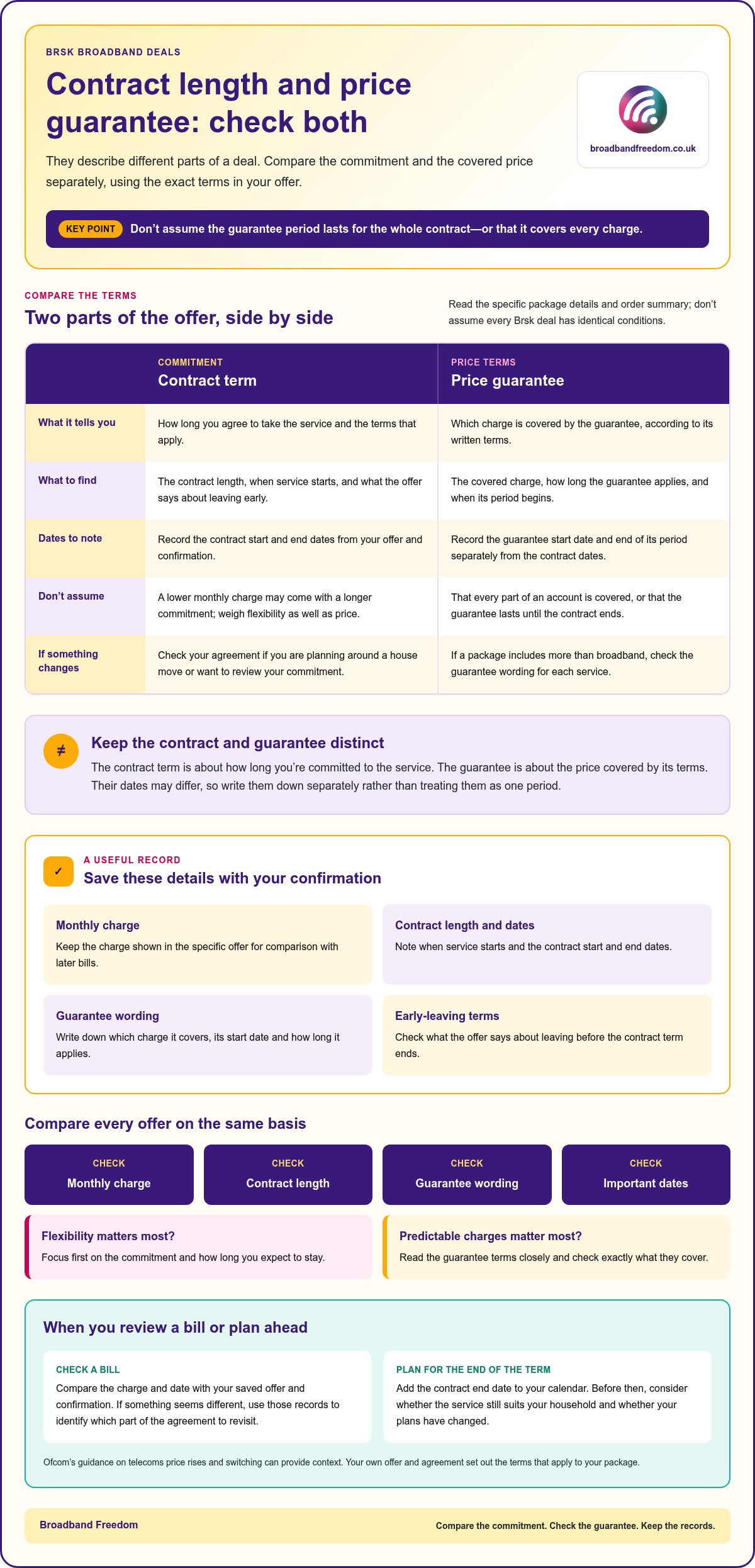
Before ordering, save the package details and confirmation. Note the contract start and end dates from those documents. This gives you a practical reference if you need to review your agreement later or plan around a house move. A lower monthly charge may involve a longer commitment, so weigh flexibility alongside the headline price.
Read the price guarantee carefully
A price guarantee applies according to its written terms. Check which charge it covers, how long it applies and when its period begins. Don’t assume it covers every part of an account. If a package includes more than broadband, read the wording for each service instead of treating the total as one guaranteed amount.
Ofcom’s guidance on telecoms price rises provides useful context for understanding how providers communicate price changes. Compare that guidance with the exact wording in your own offer. The agreement determines the terms that apply to your package.
Separate the contract from the guarantee
The contract term and price guarantee describe different parts of a deal. One concerns how long you’re committed to the service; the other covers the price included in the guarantee. Their dates may differ, so record each separately. For example, don’t assume a guarantee lasts until the contract ends unless the offer says so.
Make a short note of the covered charge, the guarantee period and its start date. Keep it with your order confirmation. When a bill arrives, compare the charge and date with those records. This helps you identify which part of the agreement to revisit if something seems different.
Plan for the end of the term
Add the contract end date to your calendar when you receive the confirmation. Before then, consider whether the service still suits your household and whether your plans have changed. A possible move, changing household needs or a desire for more flexibility can all affect what matters in your next broadband decision.
Ofcom’s consumer guidance on switching provider can help you understand the process when you’re considering a change. Keep your own contract dates and offer documents close at hand as you compare options. That way, you can make decisions based on your circumstances and agreement.
Compare offers on equal terms
Use the same checklist for each package: monthly charge, contract length, guarantee wording and important dates. Then weigh those terms against your budget and how long you expect to stay. If flexibility is a priority, focus first on the commitment. If predictable charges matter more, read the guarantee terms closely.
Keep the original offer and confirmation together, then refer to them when reviewing your account. These records make it easier to compare what you agreed with the charges and dates shown later. A careful check before ordering can make the difference between a deal that looks attractive and one whose terms genuinely fit your plans.
Full fibre speeds and reliability
What full fibre means
Full fibre uses fibre-optic cable all the way to the premises, rather than relying on another connection type for the final stretch. Ofcom’s guide to broadband speeds explains how connection type and other factors affect the speeds people experience. For a Brsk package, compare the speed details for the specific deal you’re considering. Don’t assume every package offers the same performance.
Availability is address-specific. The Ofcom broadband coverage checker can show which broadband technologies are available at a UK address. Use your own postcode when assessing options, as availability at a nearby property doesn’t necessarily tell you what’s available at home.
Match the package to daily use
Download speed affects activities such as streaming, browsing and receiving files. Upload speed matters when sending large files, backing up photos or joining video calls. Think about which tasks happen at the same time in your household, not just one person’s typical use. For example, simultaneous video meetings and streaming place different demands on a connection than browsing alone.
Make a brief list of household needs before comparing packages. Include how many people use the connection at busy times, which devices they use and any regular large downloads or uploads. Then compare those needs with the package’s advertised download and upload speeds. This gives you a more practical basis for choosing than defaulting to the biggest speed figure.
Know what advertised speed tells you
An advertised speed helps you compare packages, but it doesn’t describe every moment of your home connection. Ofcom’s guidance explains that actual speeds can be affected by factors such as the device, connection method and time of use. Check the terms for the specific package, including any speed information provided with the offer, rather than treating an advertised figure as a guaranteed result in every room.
For a useful comparison, test with the same device and connection method. A laptop connected by Ethernet beside the router isn’t directly comparable with a phone on Wi-Fi upstairs. Keep the test conditions consistent, and note whether other household members are streaming or downloading at the time.
Separate broadband from Wi-Fi
A fast broadband connection doesn’t ensure equally strong Wi-Fi in every room. The wireless signal travels from the router to each device, so distance, walls and router placement can affect the experience. If a video call works near the router but struggles in a distant room, that points to a different issue than one affecting several devices throughout the home.
Check one device near the router, then try another in the room where problems occur. If possible, compare Wi-Fi with an Ethernet connection. These simple steps can help distinguish a home wireless issue from a broader connection problem, without assuming every slow session means the fibre service itself is unreliable.
Assess reliability through patterns
Reliability means more than a high speed test result. Notice whether interruptions affect one device or several, and whether they happen at a particular time or during a particular activity. A single short slowdown tells you less than a repeated pattern across devices. Write down what happened and where, especially if the same issue returns during video calls or streaming.
For a clearer speed test, pause downloads and use the same device and location each time. Compare results taken under similar conditions, then check whether the issue persists near the router. These observations give you a more useful picture of day-to-day performance than an isolated test from a distant room.
Compare what matters to your home
Before choosing, weigh advertised speeds against your household’s busy periods, upload needs and Wi-Fi layout. If several people work or study online, consider the demands of simultaneous calls, streaming and file transfers. If usage is lighter, focus on the activities you actually do instead of choosing based only on a larger headline speed.
Use those priorities to compare broadband deals by package and connection details. A considered match between everyday use and the stated offer is a more useful starting point than speed alone.
Broadband Freedom: Broadband and Phone Packages
Broadband Freedom can help you compare broadband and phone packages if you want home internet and calling together. When weighing up a full fibre deal against another type of connection, consider how the speed, contract terms and phone service fit your household, not just the headline offer.
You can also explore broadband and TV packages, alongside the latest offers from Virgin Media and BT. This is useful if you’d rather compare different package types in one place before deciding what suits your needs. Keep your priorities clear: connection type, contract flexibility, phone or TV requirements, and the speeds your household uses.
If you’d like help comparing your options, contact Broadband Freedom.
Choose the connection that fits your next move
Your next broadband choice should fit how you expect to use your home connection, not just what you need today. If a Brsk package seems close but you’re still weighing up other connection types, compare what matters most to your household before deciding. A different speed tier or package type may suit your plans better.
Broadband Freedom offers full fibre, fibre and standard broadband deals, giving you options to compare across connection types. Consider which activities matter most at home, whether you need extra services and how much flexibility you want from your agreement. Then use those priorities to narrow your choice, rather than letting a headline speed make the decision for you.
Take the next step at your own pace. Compare broadband deals with Broadband Freedom and find an option that better matches your household’s needs.

Article by
Elaine Lang
Elaine has over 20 years across Marketing, Communications and Public Relations in the UK. She has worked across large UK corporations, including Commercial Banks and Airports, to online consumer finance and technology solutions. Elaine has post graduate qualifications in Marketing from the Chartered Institute of Marketing (CIM) and the Industry of Direct Marketing (IDM). She is a lifelong feline fan, sharing her home with around 4-6 cats for many years. This of course can be a challenge when trying to work at home, as they like to try to help!